The Archive
Haunted Locations
Dusty parish records, crumbling ruins, and restless spirits — every entry in our archive has been unearthed from the darkest corners of East Anglia.
The Archive
Dusty parish records, crumbling ruins, and restless spirits — every entry in our archive has been unearthed from the darkest corners of East Anglia.

Where ancient trees have swallowed a ruined church whole, and the roots of something older still claw upward through the earth. East Somerton's cursed ruins are Norfolk's most unsettling woodland walk.
There's a place on the North Norfolk coast, just inland from the sea at Winterton, where the trees have done something that trees shouldn't do. They've eaten a church.
St Mary's Church at East Somerton hasn't simply fallen into ruin — it's been consumed. Massive sycamores and oaks have threaded their roots through the flint walls, prised apart the windows, and woven a living tunnel through the roofless nave. The locals call it the Witch's Leg, and if you've ever stood beneath that canopy at dusk, watching the twisted limbs knot overhead like clasped fingers, you'll understand why nobody needed to explain the name.
The story goes like this: a witch was buried in the churchyard centuries ago — some say inside the church itself, beneath the nave floor, which was the privilege of the pious and the powerful, neither of which she was. The trees, they say, are her. Growing from her bones. Reaching up through stone and soil with the slow, patient fury of something that was put down but never quite died.
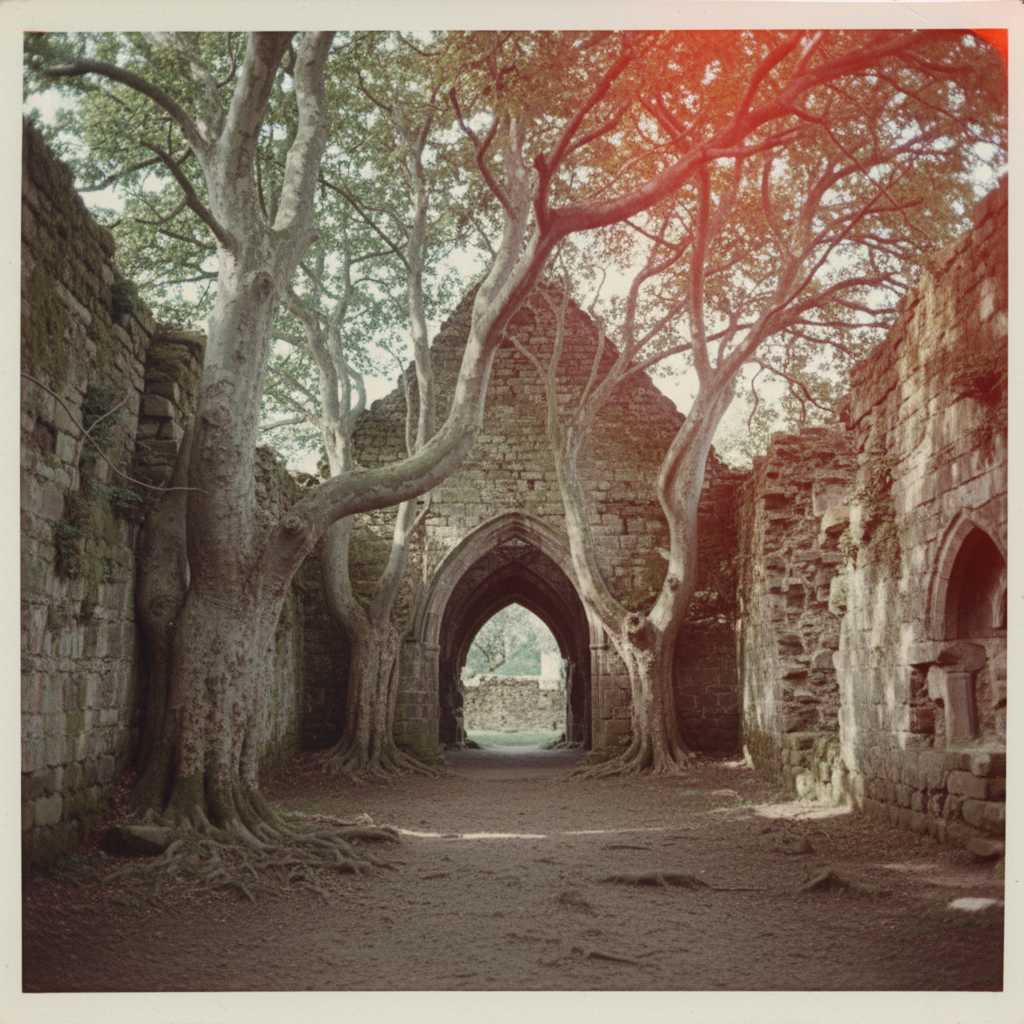
St Mary's was a medieval parish church serving the tiny hamlet of East Somerton, a settlement that has all but vanished from the map. The church fell out of use sometime in the 17th or 18th century as the population dwindled — the hamlet was never large, and the slow erosion of the Norfolk coast and the shifting fortunes of agriculture gradually emptied it.
By the Victorian period, the church was already a ruin. The roof had gone, the tower had partially collapsed, and the trees had begun their slow invasion. What makes East Somerton unusual isn't that a rural church fell into disrepair — hundreds did across Norfolk — but what happened next. Instead of being cleared, quarried for building stone, or tidied up by well-meaning Victorians, St Mary's was simply left. The trees were allowed to do as they pleased.
And what they pleased was extraordinary. The sycamores grew not around the ruins but through them, their roots following the mortar lines between the flint, their trunks rising inside the walls, their canopy closing over the nave to form a natural vault more atmospheric than anything the original builders achieved.
The witchcraft association is harder to pin down historically. Norfolk had its share of witch trials and cunning folk — the county's isolation and its deep tradition of folk belief made it fertile ground. East Somerton's witch legend may connect to the broader tradition of unconsecrated burial: if a suspected witch was buried in sacred ground, the earth itself would reject her. The trees, in this reading, are the rejection made visible — the ground literally pushing her back up.

Visitors to St Mary's report a consistent set of phenomena, and what's striking is how physical they are. This isn't a place of fleeting shadows or half-heard whispers. The Witch's Leg makes itself felt.
The most common report is a profound sense of being watched — not from any particular direction, but from below. People describe the sensation of standing on something alive, of the ground beneath their feet being somehow attentive. Several visitors have reported their dogs refusing to enter the tree tunnel, hackles raised, whimpering at the threshold.
There are temperature anomalies too. Even on warm summer days, the interior of the tree-church runs several degrees colder than the surrounding woodland. Photographers have noted that images taken inside the ruins frequently show lens flare and light anomalies that weren't visible to the naked eye — orbs, streaks, and in one widely shared photograph from 2019, what appears to be a translucent hand gripping one of the tree roots.
At dusk, the atmosphere changes. The tree tunnel darkens faster than the surrounding area, as if it's drawing the shadows in. Locals who walk the footpath past the ruins after dark report hearing sounds from inside — not voices, exactly, but a low, rhythmic creaking that doesn't match the movement of the branches. Like something stretching. Like something slowly, slowly sitting up.

The most unsettling account comes from a group of paranormal investigators who spent a night at the site in 2017. Their audio equipment captured what they describe as a long, low exhalation — a single breath lasting over thirty seconds — coming from directly beneath the nave floor. Their thermal camera showed a cold spot in the shape of a human figure, lying horizontal, in the exact centre of the ruins.
St Mary's Church is accessible via a footpath from the lane at East Somerton, about a mile inland from Winterton-on-Sea. There's no car park — you'll need to park on the verge and walk. The path is uneven and can be muddy, so boots are advisable.
The ruins are on private land but the footpath passes directly through them, and access has been tolerated for years. Be respectful — this is a genuine historical site, not a theme park.
Go at dusk. That's the honest advice. The Witch's Leg is interesting at midday, when the light filters through the canopy and the place feels merely strange. But as the light fails, as the shadows pool in the hollows between the roots, as the tree tunnel closes around you like a throat — that's when East Somerton shows you what it really is.
Bring a torch. You'll need it for the walk back. And if you feel the ground shift beneath your feet, if you hear that long, slow creak from somewhere below the stones — walk, don't run. She's been patient this long. She can wait a little longer.