The Archive
Haunted Locations
Dusty parish records, crumbling ruins, and restless spirits — every entry in our archive has been unearthed from the darkest corners of East Anglia.
The Archive
Dusty parish records, crumbling ruins, and restless spirits — every entry in our archive has been unearthed from the darkest corners of East Anglia.

Not the snarling church-wrecker of Bungay — this is the other Black Shuck. The silent one. The one that follows you along the Roman road and never, ever overtakes.
You already know about Black Shuck. Everyone in East Anglia does — the monstrous dog that burst into Bungay church in 1577, killed two worshippers, and left claw marks on the door that you can still see today. That's the famous Shuck. The loud one. The one that makes the headlines.
But there's another Shuck, and this one is worse.
The Shuck of the Peddar's Way doesn't burst into churches. It doesn't snarl, it doesn't attack, it doesn't leave marks on anything. It follows you. That's all. It walks behind you on the ancient road, matching your pace exactly, and it does not stop until you leave the path.
The Peddar's Way runs for 46 miles through the heart of Norfolk, from Knettishall Heath on the Suffolk border to Holme-next-the-Sea on the north coast. It's one of the oldest roads in England — probably pre-Roman, certainly used by the Romans, and walked continuously for at least two thousand years. It crosses heathland, farmland, and some of the emptiest countryside in eastern England.
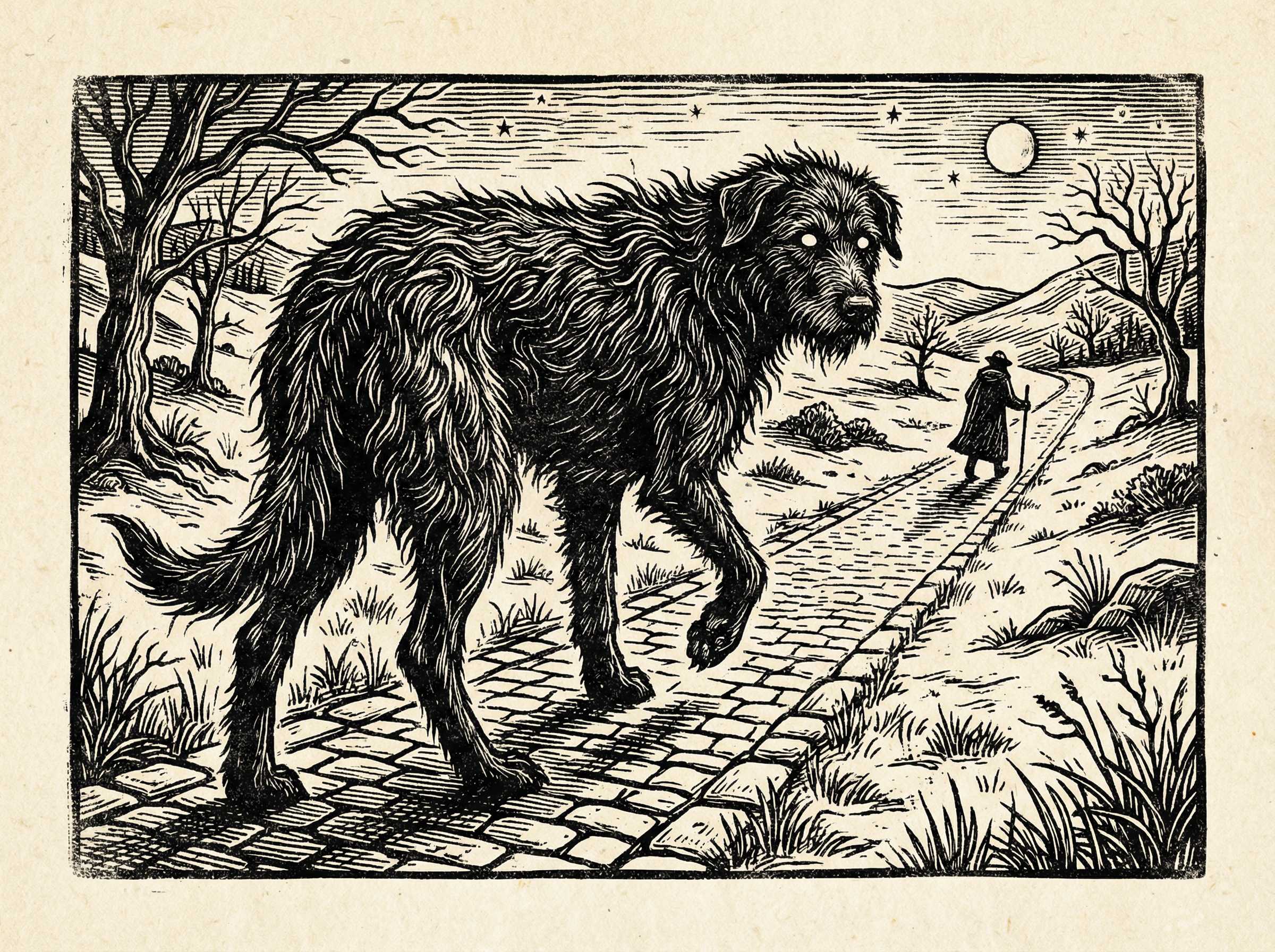
And somewhere on that road, when the light fails and the path narrows and you're alone with the wind in the gorse, the Shuck picks you up and walks behind you. Not beside you. Never beside you. Always behind, just far enough back that you can't quite see it when you turn, just close enough that you can feel it there — a presence, a weight, a pair of eyes on the back of your neck that never blink.
The Peddar's Way is ancient in a way that few English paths are. Its straight alignment — the Romans loved a straight road — cuts across the Norfolk landscape with the geometric confidence of an army that expected everything to get out of its way. Before the Romans, the route was likely a trackway used by Bronze Age and Iron Age communities, connecting the chalk uplands of the Brecks to the coast.
After the Romans left, the road persisted. Saxon settlers used it, medieval pilgrims walked it (the name may derive from the Latin "pedester," meaning on foot), and it remained a functioning route through the centuries, even as the settlements it connected shifted and changed around it.
Today it's a National Trail — well-signposted, well-maintained, and popular with walkers. In summer, it's busy enough that you'll rarely be alone. But in autumn and winter, especially on the long, empty stretches between Castle Acre and the coast where the heathland opens up and the sky drops down to the horizon, you can walk for hours without seeing another person.
That's when the Shuck walks with you.
Black Shuck — the name probably comes from the Old English "scucca," meaning demon — is Norfolk's most persistent supernatural entity. Reports of spectral black dogs span the entire county and stretch back centuries. But the dogs vary. The Bungay Shuck is aggressive, destructive, a force of chaos. The Shuck of the coastal marshes is a death omen, appearing to those about to lose a loved one. The Shuck of the Peddar's Way is something else entirely.
This Shuck is a follower. It appears behind lone walkers on the road, usually at dusk, and matches their pace with perfect precision. If you walk faster, it walks faster. If you stop, it stops — but never where you can see it. It is always just around the last bend, just beyond the last rise, just outside the range of your peripheral vision.

What you experience is the sound: soft, padded footsteps on the earth behind you, too heavy for a fox, too rhythmic for a deer. The occasional click of claws on stone where the old Roman surface breaks through. And breathing — not panting, not growling, just steady, deep breathing, the exhalation of something large and patient.
Walkers who have turned suddenly to look report catching a glimpse — a dark shape, larger than any dog, with eyes that reflect light they shouldn't be able to reflect, because there is no light to reflect. The shape freezes when spotted and is simply not there when you look again.
The Shuck of the Peddar's Way has never attacked anyone. No injuries, no deaths, no physical contact of any kind. It follows, and when you leave the path — when you turn off onto a side road, when you reach a village, when you step off the ancient alignment — it stops. It doesn't follow you home. It stays on the road.
This is what makes it unsettling. An aggressive ghost can be rationalised, even respected. A ghost that simply follows you, silently, patiently, for miles and miles along a two-thousand-year-old road, and then stops — that's harder to process. What does it want? Why does it follow? What would happen if, instead of walking away, you stopped and let it catch up?
Nobody has tried. Nobody wants to be the first.
Folklorists have noted that spectral dogs in English tradition are strongly associated with ancient paths — ley lines, Roman roads, drove roads, and pilgrimage routes. The theory is that these paths accumulate spiritual energy through centuries of use, and the dogs are either guardians of that energy (walking the line to protect it) or manifestations of it (the energy itself, given form by the expectations of the people who walk there).
The Peddar's Way, with its two-thousand-year history of continuous use, would be one of the most spiritually charged paths in England by this reckoning. The Shuck may be its guardian — not threatening walkers, but monitoring them, ensuring that those who use the road treat it with appropriate respect.
Or it may simply be lonely. Two thousand years is a long time to walk a road alone.

The Peddar's Way runs from Knettishall Heath (near Thetford) to Holme-next-the-Sea (near Hunstanton). The full trail is 46 miles and takes 2-3 days. The most atmospheric sections for Shuck activity are the long, empty stretches between Castle Acre and Fring, where the path crosses open heathland with minimal habitation.
Walk it in late autumn. Start early enough that dusk catches you on the open heath, between villages, with the gorse closing in and the sky turning that particular shade of grey that Norfolk does better than anywhere. Walk alone — the Shuck doesn't appear to groups.
And when the light drops and the path narrows and you hear something behind you — footsteps, breathing, the click of claws on old stone — don't turn around. Just keep walking. Match your pace. Stay on the road.
The Shuck walks with you, not against you. It has walked this road for two thousand years and it will walk it for two thousand more. You're just company for a mile or two. Accept it. Keep your eyes forward. And when you reach the village and step off the path, listen for the moment when the footsteps behind you stop.
That silence is the Shuck letting you go. It's the most unsettling sound on the Peddar's Way.