The Archive
Haunted Locations
Dusty parish records, crumbling ruins, and restless spirits — every entry in our archive has been unearthed from the darkest corners of East Anglia.
The Archive
Dusty parish records, crumbling ruins, and restless spirits — every entry in our archive has been unearthed from the darkest corners of East Anglia.

A thousand years of prayer doesn't stop just because the roof falls in. At Binham Priory, the Benedictine brothers are still processing through their ruined nave — and they have no intention of stopping.
Binham Priory stands in the gentle countryside between Fakenham and the North Norfolk coast, a place where the land flattens toward the marshes and the sky opens up in that particular way it does in Norfolk — endless, luminous, and faintly threatening.
What you see today is a building in two states simultaneously. The western end is the parish church of St Mary and the Holy Cross, still in use, still holding services, its congregation sitting beneath one of the earliest examples of bar tracery in England — a window so architecturally significant that it rewrites the textbook chronology of English Gothic. The eastern end is a ruin. Roofless walls, tumbled arches, the ghost of a cloister. The Benedictine priory that once stretched from here to the road is gone, dissolved by Henry VIII, quarried by locals, reclaimed by grass and jackdaws.
But the monks never left.

Binham Priory was founded in 1091 by Peter de Valognes, nephew of William the Conqueror, as a Benedictine dependency of St Albans Abbey. It was a significant foundation — well-endowed, well-connected, and architecturally ambitious. The great west window, with its pioneering bar tracery dating to around 1244, was decades ahead of Westminster Abbey's similar work.
The priory had a turbulent history. In 1327, Prior William de Somerton — a man described by contemporaries as violent, dissolute, and entirely unsuitable for monastic life — was accused of forging papal documents, assaulting fellow monks, and imprisoning a sub-prior. He was eventually removed, but not before the priory's reputation had suffered badly.
The Dissolution of the Monasteries in 1539 ended the community. The nave was preserved as a parish church, but the rest of the monastic buildings were demolished or fell into ruin. The eastern arm of the church was unroofed, the cloister was levelled, and the priory's stones were carted off for road-building and farmhouses.
But monasteries are stubborn things. The rhythms of prayer — Matins, Lauds, Prime, Terce, Sext, None, Vespers, Compline — were performed eight times daily for nearly five centuries. That's roughly 1.5 million acts of worship in the same building, in the same sequence, at the same hours. That kind of repetition leaves marks that stone and time cannot erase.
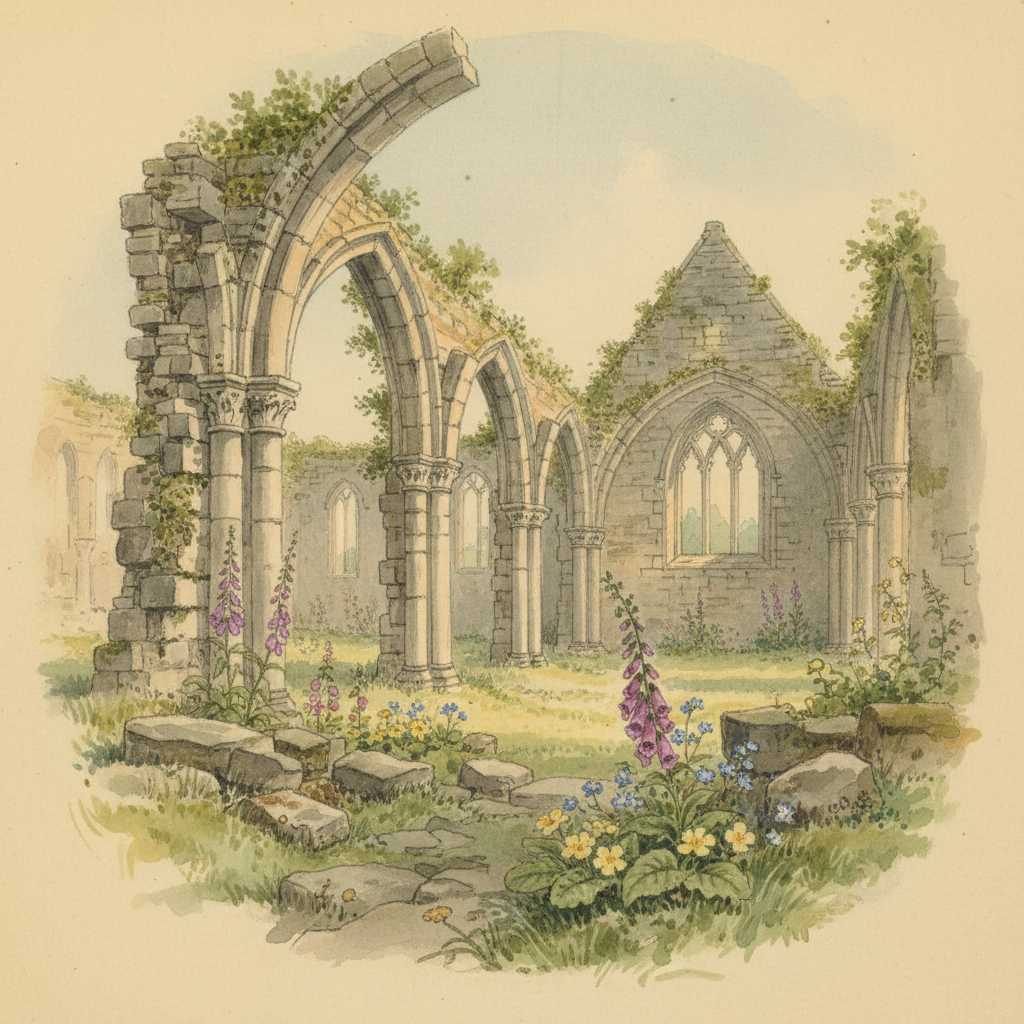
The spectral monks of Binham have been reported since at least the 18th century. The accounts are remarkably consistent: a procession of hooded figures, moving in single file through the ruined eastern end of the priory, following the line of the vanished cloister walk.
They appear most frequently on clear, moonlit nights — perhaps because that's when the ruins are most visible, or perhaps because the monks themselves are drawn to the light. The figures are described as grey or dark-robed, their hoods drawn up, their heads bowed. They move with the slow, measured pace of men processing to prayer. No sound accompanies them — no footsteps, no chanting — but witnesses consistently report a profound sense of calm followed by an equally profound unease, as if peace and fear are somehow the same thing.
The procession follows a fixed route: from where the chapter house once stood, along the line of the east cloister walk, turning at the corner, and continuing along the south walk before fading at approximately the point where the refectory door would have been. They are walking to dinner. They have been walking to dinner for five hundred years.
Inside the surviving church, phenomena are different but equally persistent. Cold spots occur in the chancel — not the gradual chill of an unheated stone building, but sudden, sharp drops that visitors describe as walking through a curtain of cold air. The sound of plainsong chanting has been reported by multiple witnesses, always faint, always seeming to come from the walls themselves rather than any identifiable direction.

A verger in the 1990s reported arriving early on a winter morning to find all the church candles lit — every one of them — despite having extinguished them himself the previous evening and locked the building. The candles were not merely lit but had burned down by exactly the amount you'd expect if they had been burning through the night offices. As if someone had been keeping the hours.
Binham is on the B1388 between Fakenham and Wells-next-the-Sea. The priory ruins and churchyard are freely accessible at all times. The church itself is usually open during daylight hours.
For the ruins, visit at any time — they're atmospheric whenever, but moonlit nights are when the monks walk. The east end of the priory, where the cloister once stood, is the epicentre of activity. Stand on the south side of the ruins after dark, looking north through the surviving arches, and wait for your eyes to adjust.
The churchyard is also worth lingering in. Norfolk churchyards have their own particular quality at dusk — the flint walls holding the last of the light, the rooks settling, the silence thickening. At Binham, you get all of this plus the knowledge that somewhere nearby, a line of hooded men is walking a path that disappeared five centuries ago, and they have absolutely no intention of stopping.