The Archive
Haunted Locations
Dusty parish records, crumbling ruins, and restless spirits — every entry in our archive has been unearthed from the darkest corners of East Anglia.
The Archive
Dusty parish records, crumbling ruins, and restless spirits — every entry in our archive has been unearthed from the darkest corners of East Anglia.

Each year on the anniversary of her execution, the ghost of Anne Boleyn arrives at Blickling Hall in a phantom coach drawn by headless horses, her severed head cradled in her lap. This grand Jacobean mansion in Norfolk — built upon the ruins of the Boleyn family seat — is one of England's most haunted houses, where cold spots, spectral weeping, and grey figures have been reported for centuries.
There are nights when the veil between this world and the next grows thin as candlesmoke, and on no night is this more apparent than the nineteenth of May at Blickling Hall. As the hour draws late and the Norfolk darkness settles like black velvet over the great Jacobean facade, those who keep vigil may witness a spectacle that has repeated itself since the year of our Lord fifteen hundred and thirty-six.
A coach approaches along the drive. It is drawn by four horses — headless, every one — their hooves striking the gravel with a sound that is felt more than heard, a rhythm that pulses through the earth itself. Upon the driver's box sits a coachman, himself bereft of his head, who guides the phantom equipage with terrible, practised certainty toward the great door of the hall. And within the coach, illuminated by a light that owes nothing to any earthly flame, sits the figure of a woman in white. She is dressed in the manner of the Tudor court, her gown rich and pale. In her lap, she cradles her own severed head.
This is Anne Boleyn. Queen of England. Second wife of Henry VIII. Executed on the nineteenth of May, 1536, upon Tower Green, by a French swordsman summoned specially for the occasion. And every year, on the anniversary of that terrible stroke, she returns to the place of her birth.
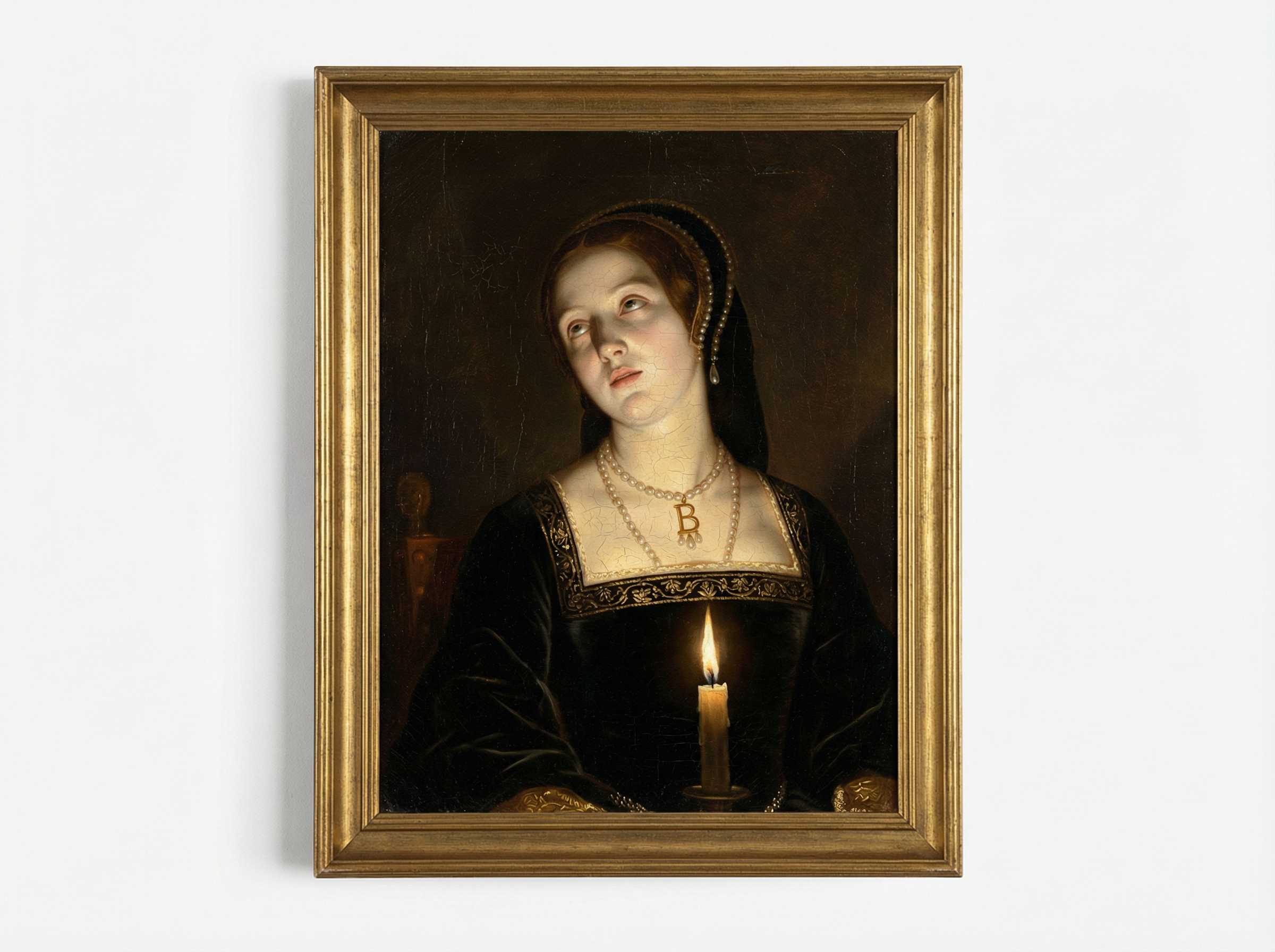
The coach arrives at Blickling Hall and then — as witnesses have attested through the centuries — it vanishes. Not gradually, not fading like morning mist, but all at once, as though it had never been. The silence that follows is, by every account, more dreadful than the apparition itself. It is the silence of something that should not be, and yet undeniably is.
Staff at the hall have reported this phenomenon across generations. Visitors who happened to be present on that date have spoken of a sudden and penetrating cold, of the scent of roses where no roses bloom, of a sound like weeping carried on still air. The phantom coach of Blickling Hall is not mere folklore. It is an annual appointment that the dead queen has never failed to keep.
To understand the haunting, one must understand the woman — and the house.
Anne Boleyn was born circa 1501, though the precise year, like so much about her, remains a matter of scholarly dispute. What is less disputed is her connection to Blickling. The Boleyn family — wealthy Norfolk gentry who had risen through trade and advantageous marriages — held the manor at Blickling for generations. It is here, in the earlier medieval hall that once stood upon this site, that Anne is believed to have spent her earliest years, though Hever Castle in Kent also lays claim to her birth. The truth, as is so often the case with the Boleyns, is obscured by time and the deliberate destruction of records that followed their downfall.
What is certain is this: Anne Boleyn captivated Henry VIII utterly. She was not the most beautiful woman at court — the Venetian ambassador noted her dark complexion and flat chest with something less than enthusiasm — but she possessed an intelligence, a wit, and a fierce will that the king found irresistible. For her, he broke with Rome. For her, he dissolved the monasteries, rewrote the laws of succession, and declared himself Supreme Head of the Church of England. The world was remade so that Henry might have Anne Boleyn.
And then he tired of her.
The charges brought against Anne in May 1536 were monstrous in their fabrication: adultery with five men, including her own brother George; conspiracy to murder the king; witchcraft. The trials were a performance, the verdicts foregone. On the morning of the nineteenth of May, Anne walked to the scaffold on Tower Green with a composure that astonished all who witnessed it. She spoke graciously of the king. She knelt. The swordsman from Calais — for even in death, Anne was afforded a certain dark courtesy — struck once. It was done.

The current Blickling Hall was built between 1616 and 1624 by Sir Henry Hobart, first Baronet, Lord Chief Justice of the Common Pleas, upon the foundations of the old Boleyn manor. It is a masterwork of Jacobean architecture: red brick, shaped Dutch gables, a long gallery of extraordinary beauty, and a library that houses one of the finest collections in private hands. But beneath the elegance and the National Trust gift shop, the bones of the Boleyn house remain. And with them, it seems, remains Anne.
Visitors to the hall have reported, quite independently of one another, encounters with a grey or white figure in the corridors and on the staircase. Cold spots manifest without explanation in rooms where fires burn. The sound of a woman crying has been heard in the small hours by staff who sleep on the premises. These are not the embellishments of guidebook writers. They are recorded observations, consistent across decades, made by people with no particular interest in the supernatural and every reason to be sceptical.
Anne Boleyn is the most celebrated of Blickling's ghosts, but she does not walk alone.
Her father, Sir Thomas Boleyn, bears a curse of his own. Thomas was a consummate political operator who used his daughters — first Mary, then Anne — as instruments of his ambition at the Tudor court. When the Boleyn faction fell, Thomas survived. He was not arrested, not tried, not executed. He simply retreated to his estates and died in 1539, three years after watching his son and daughter go to their deaths. But death, it seems, brought no reprieve from the consequences of his scheming.
According to the legend that has persisted in the Bure valley for centuries, Sir Thomas Boleyn is condemned to drive a phantom coach — his own headless horses, his own spectral equipage — across twelve bridges of the River Bure on a single night each year. It is a penance, the local tradition holds, for his role in the destruction of his children. Twelve bridges, twelve crossings, each one a station of guilt. Those who live along the river have reported hearing the thunder of hooves and the rattle of wheels on nights when no carriage could possibly be abroad, and the bravest among them claim to have seen the coach pass, driven by a figure wreathed in ghostly flame.
Then there is Sir Henry Hobart himself — not the builder of the hall, but his grandson, the fourth Baronet, who met his end in 1698 in circumstances that seem almost designed to produce a haunting. Sir Henry quarrelled with one Oliver Le Neve and, being a man of hot temper and rigid honour, demanded satisfaction. The duel was fought at Cawston Heath, and Sir Henry received a wound from which he died shortly after. His ghost is said to walk the grounds of Blickling, particularly near the lake, on summer evenings when the light is low and amber. He appears as a solid figure — not translucent, not obviously spectral — and has been mistaken, on more than one occasion, for a living person before vanishing abruptly from sight.

Blickling Hall, then, is not haunted by a single spirit but by a dynasty of them. The Boleyns and the Hobarts, bound to this place by love, ambition, violence, and the particular attachment that the dead seem to feel for the houses where they lived most intensely.
Blickling Hall is a National Trust property, open to the public from spring through autumn, with the house, gardens, and parkland each keeping their own hours. The estate sits just north of Aylsham in Norfolk, easily reached from Norwich — a drive of some twenty minutes along the A140 — and the market town itself is a pleasant base for exploration.
The house tour takes in the principal rooms, including the magnificent Long Gallery with its Jacobean plasterwork ceiling, the library with its remarkable collection of early printed books, and the intimate chambers where the atmosphere is — even by daylight — noticeably close and watchful. The gardens are extensive and beautifully maintained: formal parterre, woodland walks, a lake, and a temple. The parkland beyond stretches to over four thousand acres.
For those with an interest in the supernatural, timing is everything. The anniversary of Anne Boleyn's execution falls on the nineteenth of May. The hall is typically open on or around this date, and while the National Trust does not officially endorse ghost-hunting, evening events and late openings have coincided with the anniversary in years past. Enquire locally.
Outside the anniversary, the corridors and staircase of the house are the most frequently reported sites of unexplained activity. The cold spots tend to cluster near the east wing. Several visitors have noted an inexplicable sense of being watched in the library — a room of immense beauty but also, on certain days, of unmistakable unease.
Blickling Hall is a place of extraordinary architectural and historical significance. It is also, by the accumulated weight of testimony spanning nearly five centuries, one of the most haunted houses in England. Whether you come for the Jacobean plasterwork or the phantom coach, you will not leave unmoved.