The Archive
Haunted Locations
Dusty parish records, crumbling ruins, and restless spirits — every entry in our archive has been unearthed from the darkest corners of East Anglia.
The Archive
Dusty parish records, crumbling ruins, and restless spirits — every entry in our archive has been unearthed from the darkest corners of East Anglia.

In 1381, the Peasants' Revolt reached Norfolk — and ended in a bloodbath. The Bishop of Norwich rode in with sword and mace, and the screams of the dying still echo across the fields on midsummer nights.
On a June day in 1381, in the flat farmland south of North Walsham, the English Peasants' Revolt came to its bloody end in Norfolk.
The rebels had been riding high. Across the country, working people had risen against the Poll Tax, against serfdom, against a system that treated them as livestock with opinions. In Norfolk, the uprising was led by Geoffrey Litster, a dyer from Felmingham — a man of considerable charisma and zero military training, who had nonetheless gathered an army of several thousand and was marching across the county, burning manor houses and terrifying the gentry.
What Litster didn't count on was Henry Despenser, Bishop of Norwich. Despenser was not your typical clergyman. He was a warrior-bishop in the old mould — a man who had fought in Italy before taking holy orders and who saw no contradiction between the crosier and the sword. When news of the revolt reached him, he didn't pray for peace. He put on armour, gathered a force of men-at-arms and loyal gentry, and rode north to meet the rebels head-on.
They met at North Walsham. The rebels had barricaded themselves behind a makeshift fortification of carts, doors, and furniture — a desperate, improvised defence against mounted knights. It didn't hold. Despenser's men charged the barricade and broke through. What followed was a massacre.
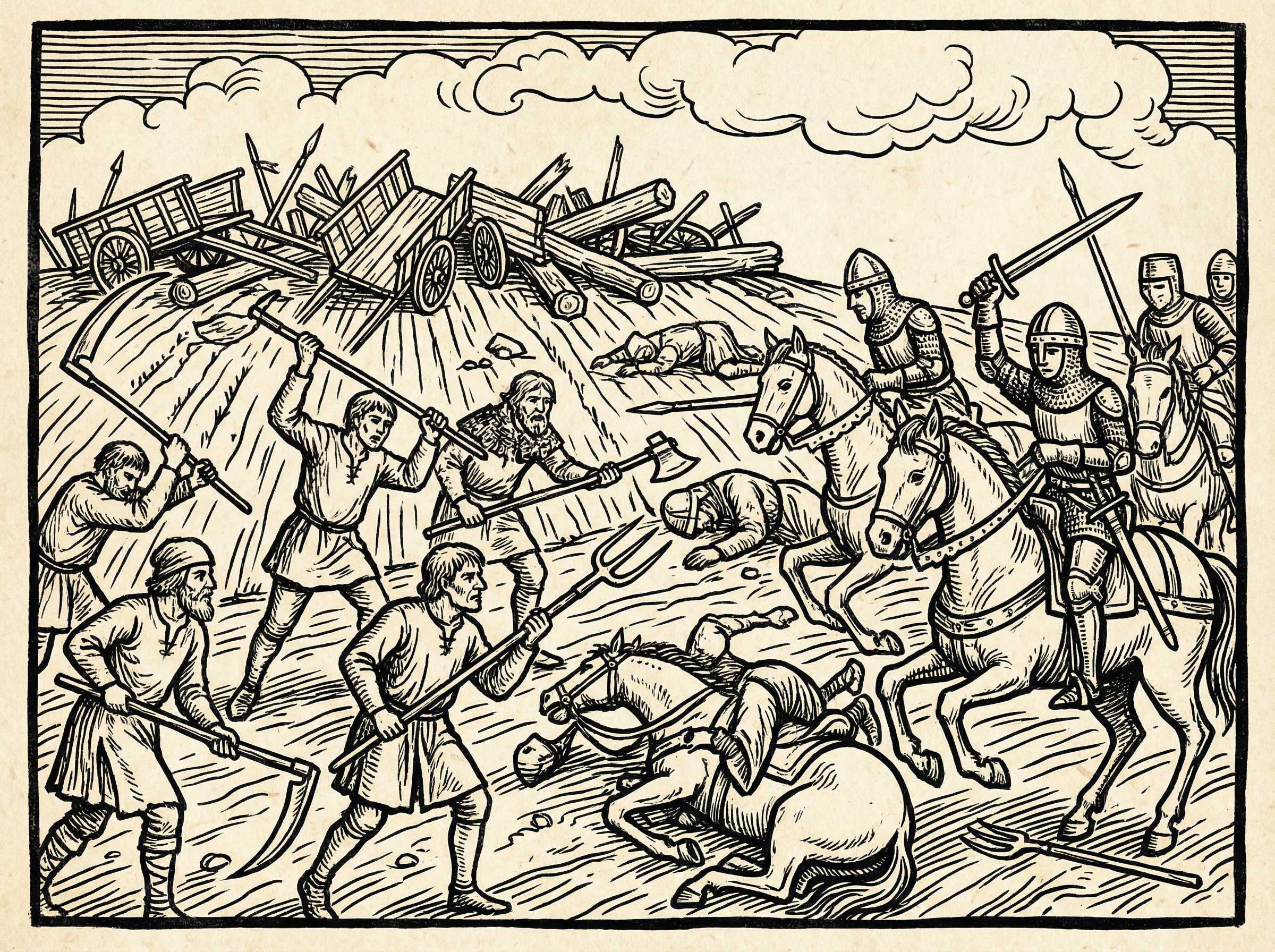
The battle was short and extraordinarily violent. The rebels, armed with clubs, farm tools, and stolen weapons, were cut down by professional soldiers on horseback. Litster was captured, given a cursory trial by Despenser personally, and hanged, drawn, and quartered on the spot. His head was sent to London. His quarters were displayed at Norwich, Yarmouth, Lynn, and — in a touch of deliberate cruelty — his own home town of Felmingham.
The Peasants' Revolt in Norfolk was over. The fields south of North Walsham soaked up the blood and grew crops over it. But the land remembers.
The exact location of the battle is debated by historians but generally placed in the fields south and southwest of North Walsham, in the area around the former site of North Walsham Abbey (now largely vanished). The landscape has changed little in 600 years — it remains open, flat arable farmland, broken by hedgerows and scattered copses, with the tower of North Walsham church visible for miles.
A cross in the churchyard of St Nicholas, North Walsham, commemorates the battle, though its exact dating and original purpose are uncertain. The church itself, with its spectacular ruined tower (partially collapsed after a fire in 1724), dominates the town and would have been visible to both armies on the day of the battle.
The battlefield has never been formally surveyed or excavated. No mass graves have been identified, though local tradition places them in several locations south of the town. The dead — perhaps several hundred, perhaps more — were buried where they fell, unmarked, unnamed, and largely forgotten by the official histories of the period.

But not entirely forgotten.
The fields south of North Walsham have been producing reports of unusual phenomena for centuries, and the consistency of the accounts is striking.
The most common report is sound. On still summer evenings — particularly around the midsummer anniversary of the battle — people in the fields report hearing what they describe as a distant commotion: shouts, metallic clashing, the thud of hooves on earth, and above it all, screaming. The sounds are faint, as if carried from a great distance or heard through a wall, but they are structured — they have the rhythm and cadence of a battle, not the randomness of agricultural noise or wind.
Farmers working the land have reported their machinery behaving erratically in certain patches of the fields — tractors stalling, GPS systems losing signal, hydraulics failing without explanation. The patches are consistent: the same areas produce the same failures, year after year. One farmer, interviewed in the 1990s, mapped the trouble spots and found they corresponded roughly to the area where historians believe the rebel barricade stood.
Visual phenomena are rarer but not unknown. A dog walker in 2003 reported seeing figures in the mist at dawn — "dozens of them, just standing in the field, not moving" — that vanished as the sun burned through. A cyclist on the Mundesley road in 2011 described a mounted figure crossing the road ahead of him at dusk, "wearing something metallic" and moving at speed, that was simply not there when he reached the crossing point.

The most affecting reports come from people who know nothing of the battle's history. Visitors to the area who feel suddenly, inexplicably sad — a crushing, physical grief that descends in certain spots and lifts when they move away. They describe it as external, not internal: not their own sadness, but someone else's, pressed upon them by the landscape. The sadness of people who died fighting for something as basic as fairness, in a field that nobody put a monument in.
North Walsham is on the A149, about 15 miles north of Norwich. The town is easily accessible and has parking, shops, and pubs.
Start at St Nicholas Church in the town centre — the ruined tower is worth seeing in its own right, and the battle cross in the churchyard sets the historical context. From there, walk south along the public footpaths that cross the fields toward Spa Common. This is the approximate battlefield area.
The fields are private farmland but the footpaths are public rights of way. Walk them at dusk on a summer evening, when the light is long and the land is quiet. The flatness of the terrain means sound carries strangely — you'll hear things from a long way off, and in the thickening light, it's not always clear what they are.
Listen for the battle. It was loud when it happened — hundreds of men fighting and dying in an open field. Six hundred years haven't been enough to silence it completely. The land is still working on it.
And if you feel that sadness — that sudden, heavy grief that arrives from nowhere and settles on your chest — stand still for a moment. Acknowledge it. These were people who wanted to be free, and they died for it in a field that has grown wheat over their bones ever since. The least we can do is feel it when we walk where they fell.